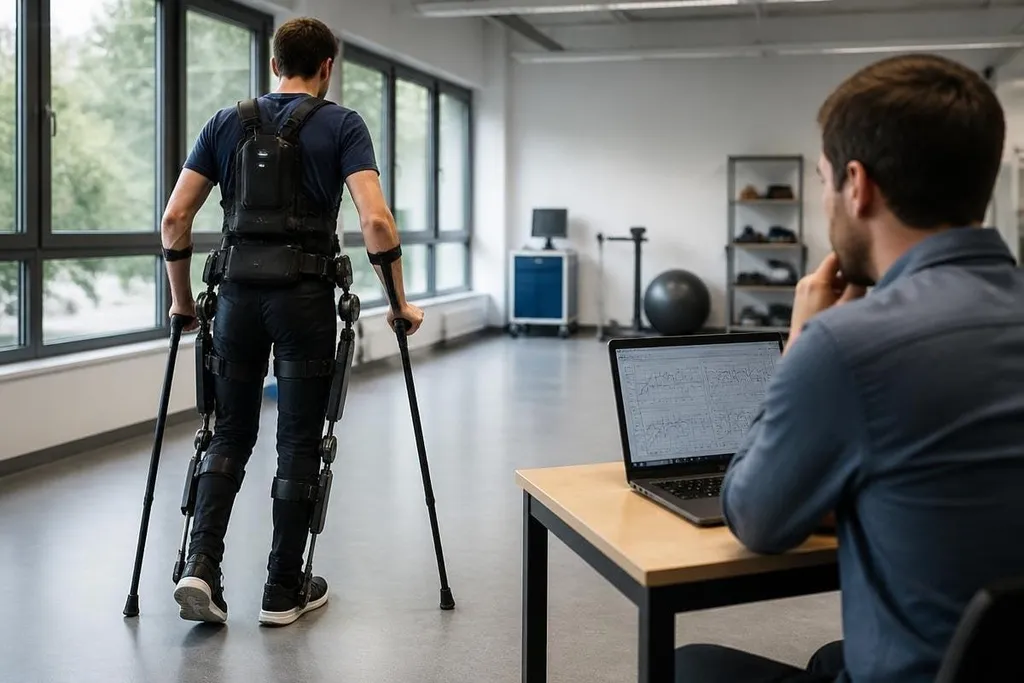
A robotic exoskeleton has to decide when to help, how much force to add, and when to stop. AI can use sensor data to make those decisions fit the person wearing the suit, but it doesn't remove the need for careful testing.
- AI reads movement, force, and position signals.
- Assistance can change as the wearer walks, lifts, or pauses.
- The open question is how well the system handles unusual movement and faults.
From fixed settings to live control
Older control systems can follow set rules. For example, a motor may add help at a certain joint angle or during a set part of a step. That approach is easier to check, but it may feel wrong when the wearer changes speed or posture.
An AI control system can compare several signals at once. Joint position shows where the limb is. Force sensors show how hard the wearer is pushing. Foot sensors can show when weight moves from one leg to the other.
The system then estimates what the wearer is trying to do and adjusts motor assistance.
That adjustment happens inside a control loop. Sensors send new readings, software processes them, and motors respond. The loop repeats while the person moves, so the suit has to work with short delays and noisy data.
The goal is not to make the exoskeleton move on its own. The goal is to make its response match the wearer closely enough that the motors help instead of fighting the movement.
Where AI can help
Walking, lifting, and rising from a chair place different demands on the body. A single motor setting may give too much help during one task and too little during another. AI can switch between control patterns as the sensor readings change.
Personal fit also matters. Two people may use the same suit with different stride lengths, strength levels, or movement habits. A model can adjust its estimate of the wearer over time, though that adjustment needs limits. A system that changes too freely can become hard to predict.
A control model needs a named exoskeleton, wearer group, task, and measured result beside its claim. AI exoskeleton reporting from Robot24.com can add a dated test record, leading to the next control problem: spotting a change in movement before assistance becomes unsafe.
AI may also help spot changes in movement. A shift in balance, joint load, or foot contact could prompt the suit to reduce assistance or ask the wearer to stop. That is a control task, not a promise that software can prevent every accident.
The limits are in the data
An AI model needs examples of the movements it must handle. Data from level walking may not prepare it for stairs, loose ground, a sudden stop, or a person who is tired. The gap matters because an exoskeleton can add force at the wrong time.
Sensors bring their own problems. A force reading can change when the suit shifts on the body. Foot contact can be hard to judge when the wearer moves slowly. Software must also deal with missing or noisy signals without producing a sudden motor command.
Training data and lab tests can't cover every body, task, and surface. That is why a serious test should record where the model works, where it asks for human control, and what happens when a sensor stops reporting.
Cost is another limit, but no price is supplied for a product here. Without a named model, buyer, or trial, any claim about savings would be guesswork. A team should ask for the full system price, service terms, training needs, and the cost of downtime.
A practical check before buying
Use these questions when a supplier presents an AI exoskeleton:
- Name the sensors: Ask which signals guide motor assistance and where each sensor sits.
- Watch the failure mode: Find out what the suit does after a sensor error, lost connection, or low battery.
- Ask for task data: Request results for the exact work, surface, load, and user group you have.
- Check human control: Confirm how a wearer or supervisor can reduce assistance and stop the motors.
- Measure the fit: Test several body sizes and record setup time, comfort, and movement limits.
- Price the whole system: Include training, repairs, software fees, batteries, and replacement parts.
I'd reject any purchase pitch that shows smooth motion but hides the test conditions. A useful exoskeleton needs clear limits, repeatable control, and a safe response when its estimate is wrong.
The next useful proof is a named system tested with the people and tasks it claims to support. Until that data is available, AI is a control method to examine, not a reason to skip the test.